
In this article, I want to share how I completed my U.S. Master’s application all by myself in the winter of 2024.
I only applied to two schools: UT-Austin (The University of Texas at Austin) and Wake Forest University (WFU).
Here’s why:
- UT-Austin has the No. 1 accounting program in the U.S. with strong academic credentials.
- WFU graduates have had the highest CPA pass rate in the U.S. for 20 consecutive years, with outstanding career support.
My Background
- I studied Accounting at China University of Petroleum (East China). I failed one math lab course in college but passed the retake. My cumulative GPA was 3.2, and my major GPA was 3.3.
- I spent my senior year as an exchange student at UC Riverside. I didn’t get an official GPA from that year, but most of my grades were B+. I listed 3.7 on my application (I was pretty casual about it, but I strongly recommend being accurate and honest with your materials).
- My TOEFL score was 79: Listening 21, Reading 19, Writing 21, Speaking 18. I took the test without preparation on a Saturday evening while working full-time. I went overtime in the speaking section, which greatly affected my score.
Application Timeline & Results
- November 20, 2024: Submitted my Wake Forest application.
- Late December 2024: Received my offer from WFU.
- January 2025: Submitted my UT-Austin application.
- Mid-February 2025: Received a rejection from UT-Austin.
Choosing Schools
Like many international students, I had dreams of Ivy League schools. But at that time, I lacked the hard qualifications to be competitive, and I also realized through working and living in the U.S. that educational pedigree isn’t always the deciding factor in career success.
I had two long-term potential goals in mind:
- Apply for a PhD in Finance in the future—when I would aim for the Ivies.
- Land a job at a public accounting firm right after my Master’s—so for now, I valued the school’s location and cost of living more.
After living in both Riverside, CA and St. Louis, MO, I fully felt the difference in cost and culture. I decided not to return to California or stay in Missouri.
I chose to head east. I had a few friends studying at NYU and asked about their cost of living and lifestyle. After careful thought, I decided not to attend school in New York, but I did want to work there someday.
That’s why I looked for schools near New York that also had strong accounting programs—Wake Forest became my top pick.
Then I explored popular programs among Chinese applicants, like UIUC (University of Illinois Urbana-Champaign) and UT-Austin.
At that stage, I was what we call a “three-nothing” applicant:
- No TOEFL/IELTS score (yet)
- No GRE/GMAT
- No recommendation letters
These three are essential for most Top 50 U.S. grad schools. Some programs waive the GRE/GMAT, but TOEFL/IELTS is required for all international applicants (except for U.S. undergrads). Most schools ask for at least one academic and one professional recommender, sometimes two or more.
Considering my situation, I decided not to waste time on the GRE/GMAT and instead focused on taking the TOEFL.
Of course, this was a tough call. I was working full-time and didn’t have much energy to study. Some people used proxies to take tests for them—for around $1,500-4,000, you could buy a high score. I was tempted too. I figured I could work, save, and just buy my way out.
But I gave it up. It was too risky, and I still believed I could pass the TOEFL on my own. And my inner person told me if I cheat once, I’ll cheat twice and more which is not what I want to do and it will destroy my honest spirit. So I decided to only apply to schools that didn’t require the GRE.
Eventually, I made a shortlist:
- Wake Forest (I liked the name and their career support)
- William & Mary (also liked the name)
- UIUC (considered it but too close to Missouri—I wanted to go further)
- UT-Austin (applied after receiving the Wake Forest offer)
Even though my school choices weren’t typical, I was overly confident that if I worked hard, I could pass all the tests and maybe get into an Ivy in the future.
Then reality hit: a 79 on the TOEFL. I realized I had to find an alternative way to bypass rigid requirements.
I began browsing the official websites of the schools I was applying to.
Wake Forest stood out first—it was easy to schedule a meeting with the admissions office via their MSA webpage.
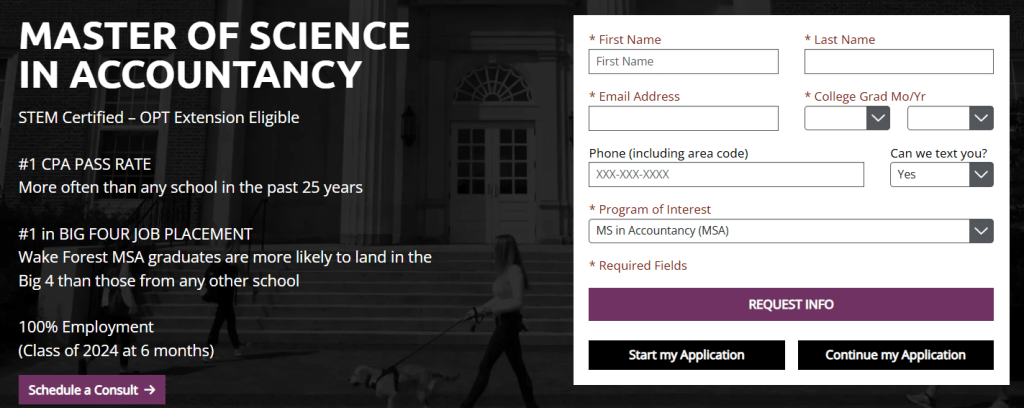
I also found that their average admitted profile included GPA 3.6, GMAT 647, and TOEFL 100+. I needed to assess whether this school placed too much emphasis on hard stats. If they did, I’d skip it and look for programs that valued softer strengths.
When I scheduled the consultation, I had two goals:
- My TOEFL speaking score was weak, but I speak fluently in daily life. A live meeting would allow them to see that firsthand.
- I wanted to ask about a GMAT waiver. Their criteria mentioned GPA above 3.2 and 2 years of study/work in the U.S. (though it changes slightly every year).
Two days later, I received a response. The admissions officer I met was very friendly. We started with small talk about the campus weather and seasons. I gave a full self-introduction as if it were an interview, then asked about application procedures, timelines, and materials.
After he answered, I shared that I had studied at UCR for a year and had nearly a year of full-time work in the U.S. I explained that although I didn’t have a U.S. bachelor’s degree, my English ability had been proven through school and work. I asked if this might qualify me for a TOEFL waiver.
He was unsure and said probably not, but he’d ask the team that handles that decision.
I mainly asked this to lead into my GMAT waiver request.
Then he asked my TOEFL score. I asked about their minimum, and he said 79.
Perfect—I told him I had exactly 79, but the speaking section was affected by a technical issue. He said that wouldn’t be a big deal since they emphasize overall strength and essays.
I then pointed out that I had a GPA of 3.2 and two years of U.S. experience. He said the GMAT waiver should be no problem and he would help with that.
He asked why I wanted to apply to Wake Forest. I said it was the only school I planned to apply to this cycle. I admired their CPA pass rate, read positive reviews from Chinese students online, and believed I’d enjoy the school’s culture and community.
The officer then gave me an application fee waiver and told me I could skip one of the short essays.
The next day, I received a confirmation that my GMAT was waived. On the third day, I submitted my full application.
My Essays and Interview Reflections
Essay Question 2: What are the characteristics of a leader you admire and how does that influence your leadership style?
Before I answer this question, I want to share why I came to America. In China, I read What It Takes, Shoe Dog, and The Ride of a Lifetime—stories about Blackstone, Nike, and Disney. I also read books about Chinese companies, but I realized the key difference between Chinese and American companies lies in creativity and compassion. This realization inspired me to come to America to learn about company culture, which I believe is shaped by its leaders. I admire leaders who are passionate, hard-working, driven, and empathetic. (If you’ve read the previous article I had, you would find that this is the similar answer as my interview for jobs)
While studying at UCR, I read about Steve Jobs, who became someone I deeply respect. Although he could be tough, the most valuable lesson I learned from him is his appreciation for talented people. In my view, there’s no single “best” or “worst” type of leader; great leaders are those who guide their teams to success while ensuring their teammates are rewarded fairly for their contributions.
Before coming to the U.S., my leadership style was highly structured and goal-driven. I often planned meticulously, assigned tasks randomly, and pushed hard to control outcomes because I lacked trust in my teammates’ abilities. Teammates felt more like tools to complete projects than collaborators and I never saw their true colors.
However, after learning about some American companies, especially Netflix, I began understanding my teammates’ personalities, goals, and areas they wanted to develop. By aligning tasks with their strengths and interests, I saw their performance improve dramatically, and I built stronger relationships. I no longer needed to push as hard—they became self-motivated. My year at UCR transformed me into a leader who is not only goal-oriented but also empathetic, supportive, and focused on team growth. 🙂
I also got feedback from my old teammates and new teammates. I believe that if I keep my leadership style, I can not only be their leader but also become the mentor.
Essay Question 3: What makes you happy and why?
What makes me truly happy is striving to grow beyond myself and helping others achieve their goals. I am naturally competitive and ambitious, always setting new challenges to improve daily.
Initially, I led a rigid, highly planned lifestyle, aiming to make every minute productive. However, this often led to stress and disappointment when plans didn’t go perfectly.
Over time, I embraced a more flexible mindset, focusing on progress rather than perfection. Whether it’s reading, exercising, or connecting meaningfully with others, I now find joy in small efforts that contribute to growth and learning, making each day fulfilling.Helping others succeed brings me even greater happiness. As I learned during my leadership experiences at UCR, supporting my teammates in unlocking their potential and celebrating their achievements is incredibly rewarding. After each project, I held feedback sessions to express my gratitude, share advice, and listen to my teammates’ perspectives.
Moments like a shy teammate opening up to share her feelings and thanking me for my encouragement, or others celebrating their new skills, filled me with a deep sense of joy and purpose. These experiences taught me that life’s greatest meaning comes from the relationships we nurture and the positive impact we create.
While personal accomplishments are gratifying, the happiness of seeing others thrive is unparalleled.Life is enriched when we bring smiles to others’ faces by helping them achieve their dreams. Life’s short—we should make ourselves happy and bring happiness to others.
Kira Interview Reflection: “Who is the living person you most want to meet?”
A few years ago, my mom told me about her friend’s child who got into Harvard. During the interview, the admissions officer asked, “If you could meet any person, living or dead, who would it be?”
She answered: Li Bai, the ancient Chinese poet. She wanted to know how he maintained his free-spirited poetry and idealism through dynastic turmoil and shifting power structures. She hoped to find strength from his romanticism and courage.
When my mom asked me the same question, my first thought was Warren Buffett or Charlie Munger. But after more thought, I told her I wanted to meet Elon Musk.
In my Kira interview, I gave the same answer:
I want to meet Elon Musk and learn more about his plans for Mars colonization. I’ve always been curious about how major companies operate—how they make decisions and seize opportunities others can’t see. What impresses me most about Elon Musk is how he spans multiple industries—Neuralink, SpaceX, Tesla, The Boring Company—each pushing boundaries in unique ways. I also want to ask what drives his passion for space. Does he know something about Earth or the universe that makes him feel an urgency to build a future elsewhere? What are the emerging industries that everyday people can join? Beyond the tech, I’d love to learn how he manages risk, stays focused through setbacks, and builds teams around seemingly impossible missions. Meeting him would be an incredible opportunity to learn not only about the future of industry but also about the mindset needed to create it.
Reflections on the UT-Austin Application
After submitting my Wake Forest application, I honestly became a bit lazy. But because WFU only ranks within the Top 50 in the U.S. and is relatively unknown in China, my mom kept encouraging me to apply to a higher-ranked school. So once I received my offer from Wake Forest, I decided to apply to UT-Austin.
To be honest, I knew from the beginning that UT-Austin might not be the right fit for me. It’s a highly research-focused university with a strong emphasis on academic background and standardized test scores. Their essay questions also reflected that focus—for example, one prompt asked applicants to describe academic or professional experiences that led them to pursue a master’s in accounting.
Truthfully, I’m not great at answering highly specific academic questions. Wake Forest’s questions were more about getting to know the candidate personally, so I wrote each of those essays myself and carefully refined them. For UT-Austin, I gave my resume to ChatGPT and asked it to help draft the essay, which I then edited.
But beyond the essays, I had two big concerns: my TOEFL score and recommendation letters.
After submitting my application and TOEFL score, I also booked a consultation with UT-Austin’s admissions team. I explained that my score was 79 and asked if I should retake the test. They told me it would be best to aim for 100 and send them the updated score.
Additionally, UT required at least two recommenders to submit letters directly online. I contacted three people: my professor from China, my former internship manager, and a professor from UCR who had earned his PhD at UT-Austin.
The admissions officer mentioned that recommendations from UT alumni or faculty could significantly improve my chances. That gave me hope. I called the UCR professor, and he agreed to write a recommendation letter. But I waited for a month, and even after I received UT’s rejection letter, he still hadn’t replied to my emails or submitted the letter.
On a side note, I really appreciated Wake Forest’s approach to recommendations. Instead of requiring formal uploads with signatures, applicants only needed to provide contact information. The admissions team would reach out to the recommenders directly by phone or email. I really liked that workflow—it felt more personal and efficient.
Final Thoughts on the 2024–2025 Application Season
To be honest, this isn’t one of those “perfect applicant success stories” you see online. My GPA wasn’t 3.9. I didn’t have a 110+ TOEFL score, a high GRE, or an internship at a Fortune 500 company. I got one offer, and one rejection.
But no matter what, I’ve always believed: if it’s something I truly want to do—and I commit myself to it—I’ll get it done.
Thank you for reading my journey. If you’re going through the application process or just thinking about your next steps, I hope this story encourages you to take action, ask questions, and believe in your own path.
Feel free to leave a comment or connect—I’d love to hear your story too.ite article with formatting, SEO title, or cover image suggestion!






 A Wanderer’s Reflection
Leave a comment