
Tax credits are among the most powerful tools in the U.S. tax code, and they reduce what you owe dollar-for-dollar, not just your taxable income. Knowing which ones apply to you could mean hundreds or even thousands of dollars back in your pocket each year.
What Is a Tax Credit, Really?
A tax credit directly reduces the amount of tax you owe to the federal government. Unlike a deduction, which lowers your taxable income and saves you only a fraction of the deducted amount – a credit cuts your tax bill by the full credit amount. A $1,000 credit saves you exactly $1,000.
Some credits are refundable, meaning if they exceed your tax liability you receive the remainder as a refund. Others are non-refundable, they can reduce your bill to zero, but no further. Understanding this distinction is the first step to maximizing your benefit.
Individual and Family Credits
Child Tax Credit (CTC)
If you have a child, you may be eligible for the Child Tax Credit. For 2025, the credit is up to $2,200 per qualifying child. To qualify, you (or your spouse, if married filing jointly,) and each qualifying child must have a Social Security number that is valid for employment in the United States and issued before the due date of the tax return (including extensions). Additionally, a child must:
- Be under age 17 at the end of 2025,
- Be claimed as a dependent on your tax return, and
- Meet other criteria.
A portion of the credit may be refundable as the Additional Child Tax Credit (ACTC), up to $1,700 per qualifying child for 2025.
Child and Dependent Care Credit
- This one is tied to actual childcare spending, specifically, expenses you paid so you could work or look for work
- The credit is for expenses related to the care of a child under age 13 (or a disabled dependent of any age) so the taxpayer can work or look for work.
- The credit is 20 – 35% of your eligible expenses (the percentage depends on your income, lower earners get the higher 35%)
- But there’s a cap on how much spending counts:
- $3,000 max for one child/dependent
- $6,000 max for two or more
- So the maximum possible credit is $600 – $1,050 for one child, or $1,200 – $2,100 for two or more
- This credit and the Dependent Care FSA cannot provide duplicate tax benefits for the same expenses; the portion reimbursed or provided by the employer on a pre-tax basis is generally deducted first from the expenses eligible for the credit calculation.
Earned Income Tax Credit (EITC)
The EITC is a refundable credit designed for low-to-moderate income workers. The credit amount scales with your earned income and the number of qualifying children in your household. Even taxpayers without children may qualify if they are between ages 25 and 65. For married filing jointly (MFJ), only one spouse needs to meet the age test.
To qualify, you must have under $11,950 in investment income and earn less than a specific income level from working. The income level ranges from: $19,104 if you’re single with no children to $68,675 if you’re married filing jointly with 3 or more children. For more details, see Earned Income Tax Credit.
Adoption Credit
The adoption credit is designed to offset the cost of adopting an eligible child. For 2025, qualified adoption expenses are limited to $17,280 per child, and the credit phases out at higher income levels.
IRS guidance also notes that for tax year 2025, a portion of the adoption credit may be refundable, up to $5,000 per eligible child
Education-Related Tax Credits
Two major credits exist for higher education costs. You can use both over a lifetime, but never for the same student in the same year.
American Opportunity Tax Credit (AOTC)
- Maximum credit: $2,500 per student
- Covers 100% of the first $2,000 in tuition, fees, and course materials, plus 25% of the next $2,000
- Available for the first 4 years of undergraduate education only
- Up to $1,000 (40%) is refundable
- Your modified adjusted gross income must be $90,000 or less ($180,000 or less for married filing jointly) to claim the credit.
Lifetime Learning Credit (LLC)
- Maximum credit: $2,000 per taxpayer
- Covers 20% of the first $10,000 in tuition and fees (course materials excluded)
- Available for any year of higher education, including graduate courses
- Not refundable; phases out for higher-income filers
Key rule: You can use the AOTC and LLC in a lifetime, but not for the same student in the same tax year.
Retirement Savings Contribution Credit (Saver’s Credit)
This credit rewards lower- and middle-income taxpayers who contribute to a traditional or Roth IRA. To qualify, you must be:
- At least age 18
- Not a full-time student
- Not claimed as a dependent on someone else’s return
The maximum contribution amount eligible for the credit is $2,000 per person ($4,000 if married filing jointly), and the maximum credit is $1,000 per person depending on filing status and income. The credit rate may be 10%, 20%, or 50%.
Income Requirements: For the 2025 tax year, the income threshold for married couples filing jointly is $79,000, and for single individuals or married individuals filing separately, it is $39,500.
Other Key Personal Credits
W-2 Withholdings & Excess Social Security
If you worked for two or more employers in a year, each may have withheld the correct individual Social Security tax, but together they may have exceeded the annual Social Security tax limit. That excess withholding is treated as a credit against your income tax liability, returning the over-withheld amount to you.
Credit for the Elderly or Permanently Disabled
This credit is available to taxpayers who are age 65 or older, or who are under 65 and retired due to a permanent disability. The credit equals 15% of eligible income.
Foreign Tax Credit
If you paid income taxes to a foreign government, you generally don’t have to pay U.S. tax on the same income twice. You can either:
- Take a dollar-for-dollar credit for foreign taxes paid, or
- Deduct those taxes as an itemized deduction
The credit is almost always more valuable than the deduction, since it reduces your tax bill directly rather than just your taxable income. Individuals typically use Form 1116 unless an exception applies.
Premium Tax Credit
If you buy health insurance through the Health Insurance Marketplace and meet other criteria, you may be able to claim the Premium Tax Credit. This is a refundable credit based on your income and the cost of your healthcare plan.
General Business Credit (GBC)
The GBC is a collection of many smaller business credits bundled together with a shared limitation formula. Key rules:
- Only the first $25,000 of income tax may be completely eliminated
- Any remaining income tax liability can be reduced by a maximum of 75%
Small Business Credits
Small Employer Retirement Plan Start-Up Credit
Covers ordinary and necessary costs of setting up and administering a new qualified retirement plan.
Small Business Health Care Tax Credit
Available to small employers. Covers up to 50% of health insurance premiums paid on behalf of employees enrolled in a qualified plan through the Small Business Health Options Program (SHOP).
Residential Energy & Vehicle Credits
Residential Clean Energy Credit
A nonrefundable credit generally equal to 30% of the cost of qualified residential clean energy property, including solar electric panels, solar water heaters, wind energy systems, geothermal heat pumps, fuel cells, and battery storage technology.
Under current IRS guidance, the credit applies to qualifying property installed from 2022 through December 31, 2025. In general, there is no annual or lifetime dollar limit, except for certain fuel-cell limitations.
Energy Efficient Home Improvement Credit
If you make qualified energy-efficient improvements to your home after January 1, 2023, you may qualify for a credit equal to 30% of certain eligible costs. The credit can be claimed for qualifying improvements made through December 31, 2025. The maximum credit is generally up to $3,200 per year.
The annual limits are:
- Up to $1,200 for certain energy-efficient property costs and home improvements, including limits of $250 per exterior door ($500 total), $600 for exterior windows and skylights, and $150 for home energy audits.
- Up to $2,000 for qualified heat pumps, heat-pump water heaters, biomass stoves, and biomass boilers.
Clean Vehicle Credit
For eligible vehicles, the credit for a new clean vehicle may be worth up to $7,500, while the credit for a used clean vehicle may be worth up to $4,000. Eligibility depends on several requirements, including modified adjusted gross income (MAGI) limits. Under current IRS guidance, these credits are generally not available for vehicles acquired after September 30, 2025, subject to the IRS transition rule for certain vehicles placed in service later.
Alternative Fuel Refueling Property Credit
A credit of 30% of installation costs for qualified alternative fuel vehicle refueling property installed in the home, with a maximum credit of $1,000.
Where to Start
Tax credits can dramatically reduce or even eliminate what you owe. A few action steps worth taking before you file:
- Review your family situation: dependents, childcare costs, and adoption expenses all unlock credits
- Check your education expenses: the AOTC alone is worth up to $2,500 per student
- If you made retirement contributions, confirm whether you qualify for the Saver’s Credit
- If you installed solar panels, bought an EV, or made home energy upgrades, gather those receipts
- If you’re a small business owner, explore the GBC cluster, the health care and retirement plan credits are often overlooked
Tax law changes frequently. Always verify current limits and phase-out thresholds with the IRS or a qualified tax professional before filing.
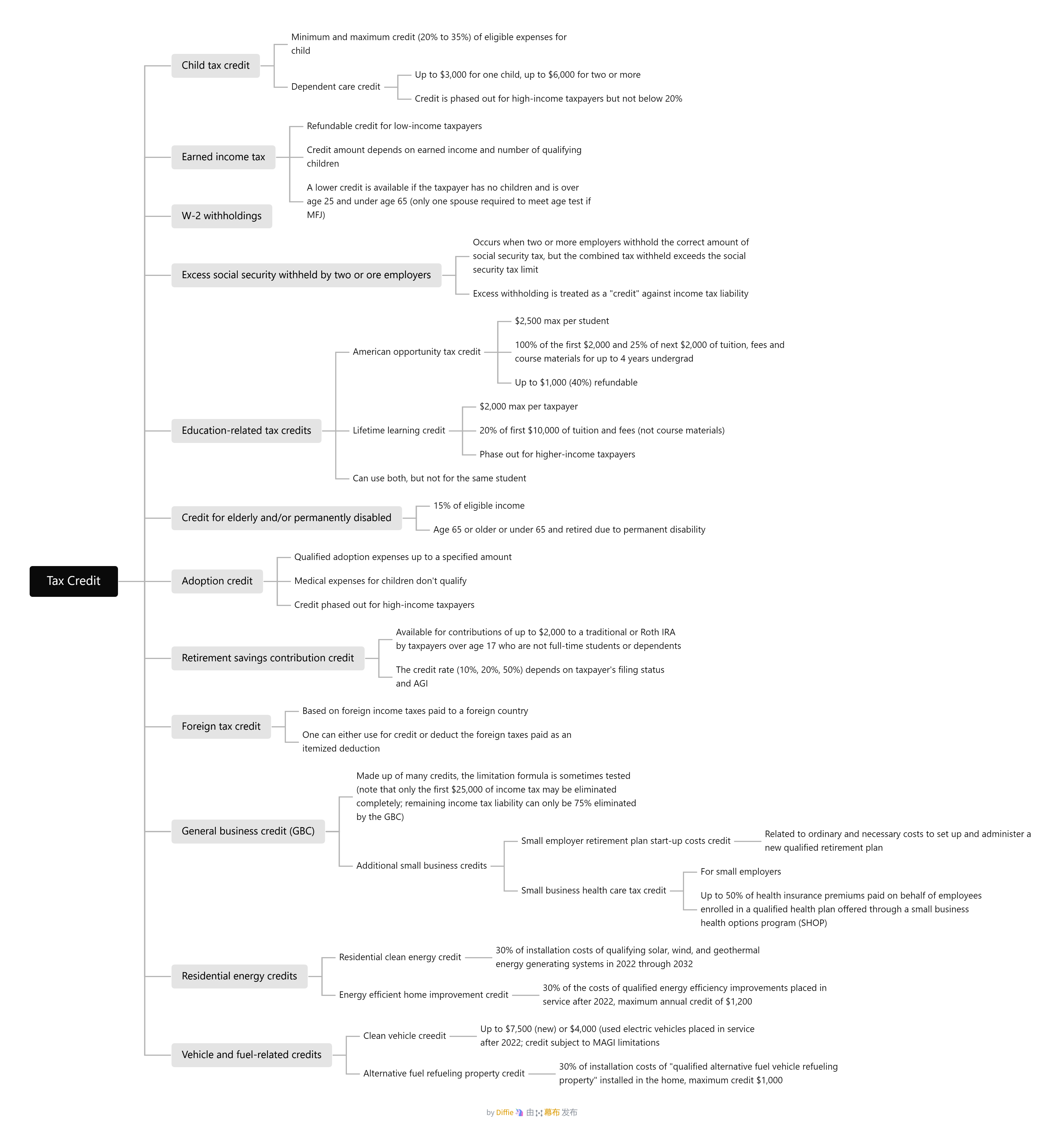
Diffie’s mindmap:





 A Wanderer’s Reflection
Leave a comment