
It’s been a long time I didn’t update, but here we go! I used a slightly attention-grabbing title this time but as long as you come and learn accounting with me, I’m happy. : D
Recently, while studying the final section of FAR for the CPA Exam: Not-for-Profit Accounting (NFP), I also spent some time reviewing how charities and foundations operate in the United States.
This article will remain primarily focused on accounting concepts and CPA Exam logic. At the end, I will also include a few practical examples involving charitable giving and how high-net-worth individuals may structure donations.
Because many readers are also preparing for the U.S. CPA Exam, I will retain the commonly tested accounting terminology in English where appropriate.
Part 1: The Financial Reporting Framework of an NFP
Not-for-Profit Accounting is a relatively independent section of CPA FAR, but the underlying logic is actually very concentrated.
When students first encounter NFP accounting, many familiar concepts such as:
- Retained Earnings
- Stockholders’ Equity
- Net Income
are no longer the main focus.
Instead, the terminology shifts toward:
- Net Assets
- Donor Restrictions
- Contributions
- Conditional Contributions
- Fundraising
Although these terms may initially seem unfamiliar, the core concepts are not especially complicated.
Most NFP questions ultimately come down to three issues:
- What is the nature of the resource or transaction?
- When should it be recognized?
- Once recognized, is it subject to a donor-imposed restriction?
Once these three questions are clear, the relationship among Financial Statements, Contribution Revenue, and Net Asset Classification becomes much easier to understand.
Part 2: Statement of Financial Position
Nonprofit organizations and commercial enterprises have different objectives.
A commercial enterprise generally seeks to generate profits and create value for shareholders.
A nonprofit organization, by contrast, operates primarily to accomplish an organizational mission.
As a result, its financial reporting places greater emphasis on:
- The resources controlled by the organization
- Whether those resources are restricted
- How those resources are used to accomplish the organization’s mission
For FAR purposes, the three principal financial statements are:
- Statement of Financial Position
- Statement of Activities
- Statement of Cash Flows
The Statement of Financial Position can be understood as the NFP equivalent of a Balance Sheet.
A traditional business generally follows:
Assets = Liabilities + Stockholders’ Equity
An NFP does not have shareholders in the traditional sense, so instead of Stockholders’ Equity, it reports Net Assets.
The basic relationship is:
Assets − Liabilities = Net Assets
Net Assets are generally divided into two major categories.
Net Assets Without Donor Restrictions
These are resources that are not subject to donor-imposed restrictions.
The organization can generally use these resources in accordance with its mission and operating needs.
For example, assume a charity receives a general donation of $100,000.
The donor does not specify a particular use and does not require the organization to wait until a future period before using the funds.
The contribution would generally increase:
Net Assets Without Donor Restrictions
Net Assets With Donor Restrictions
If a donor limits the use or timing of a contribution, the related amount may be classified as:
Net Assets With Donor Restrictions
For example, assume a donor contributes $500,000 to a university and specifies:
The funds may only be used for student scholarships.
The university has received the resource, but it cannot use the money for office rent, administrative salaries, or unrelated programs.
Therefore, the contribution is subject to a donor restriction.
Part 3: Who Created the Restriction?
This is an important distinction for the CPA Exam.
The restriction that affects Net Asset Classification is generally a:
Donor-imposed restriction
For example, assume the Board of Directors decides to reserve $500,000 for a future construction project.
This is an internal management decision rather than a donor restriction.
Therefore:
Board designation ≠ Donor restriction
An internal decision to designate funds for a particular purpose does not automatically cause the amount to be classified as Net Assets With Donor Restrictions.
Part 4: Statement of Activities
The Statement of Activities can be viewed as the NFP equivalent of an Income Statement.
It reports items such as:
- Revenue
- Gains
- Expenses
- Losses
and ultimately presents:
Change in Net Assets
A commercial enterprise often focuses on:
Net Income
An NFP, however, focuses more heavily on:
Change in Net Assets
The organization must also distinguish changes between:
- Net Assets Without Donor Restrictions
- Net Assets With Donor Restrictions
This distinction is important because financial statement users need to understand not only how much revenue an organization has received, but also how much of that revenue is available for general use and how much remains subject to donor restrictions.
Part 5: NFP Expense Classification
Expense reporting for NFPs has an important additional dimension.
Expenses can be classified by both:
- Nature
- Function
Nature describes what the expense is.
Examples include:
- Salaries
- Rent
- Supplies
- Depreciation
- Professional Fees
Function describes the purpose the expense serves within the organization.
The principal functional categories commonly tested are:
- Program Services
- Management and General
- Fundraising
Program Services
Program Services are activities directly related to accomplishing the organization’s mission.
For an educational nonprofit, examples may include:
- Teaching programs
- Student support
- Educational activities
For a healthcare charity, examples may include:
- Free medical services
- Patient assistance
- Community health programs
Management and General
Management and General includes administrative activities necessary to operate the organization as a whole.
Examples may include:
- Accounting
- Human Resources
- General Administration
- Management Functions
Fundraising
Fundraising includes activities related to obtaining contributions.
Examples include:
- Fundraising Campaigns
- Donor Solicitation
- Charity Dinners
Therefore, NFP expense classification is not limited to determining whether a cost is Salary Expense or Rent Expense.
The exam may also ask:
What function does this expense serve?
Part 6: Statement of Cash Flows
NFPs also prepare a Statement of Cash Flows.
The overall framework is similar to that used by commercial enterprises:
- Operating Activities
- Investing Activities
- Financing Activities
NFP accounting does not use an entirely separate cash flow model.
However, certain contributions and donor restrictions can affect the classification of specific cash flows, so the economic substance of the transaction remains important.
Part 7: Contribution vs. Exchange Transaction
Contribution Accounting is one of the most important areas in NFP accounting.
The first step is to distinguish between:
Contribution
and
Exchange Transaction
Contribution
A contribution occurs when one party voluntarily transfers resources to an NFP without receiving approximately equivalent value in return.
For example, assume an individual donates $20,000 to a charity.
The charity does not provide goods or services worth approximately $20,000 in return.
This is a:
Contribution
Exchange Transaction
If the payer receives approximately equivalent value in return, the transaction is generally more similar to an ordinary exchange transaction.
For example, if an individual pays an NFP $500 and receives goods with a fair value of approximately $500, the transaction is closer to an Exchange Transaction than a pure contribution.
A single transaction can contain both components.
Assume a charitable organization hosts a Fundraising Dinner.
A participant pays:
$1,000
The fair value of the dinner is:
$250
The payment may be divided into:
- $250 Exchange Component
- $750 Contribution Component
Therefore:
Cash received does not automatically equal Contribution Revenue.
The key concept is whether the payer receives:
Commensurate Value
or approximately equivalent value in return.
Part 8: Conditional Contributions
Before recognizing Contribution Revenue, it is necessary to determine whether the contribution is subject to a Condition.
A conditional contribution generally requires the NFP to satisfy a specified barrier before it becomes entitled to the resources.
For example, assume a foundation tells a charity:
If you raise $1,000,000 from other donors, we will contribute an additional $500,000.
The charity has currently raised only:
$600,000
The requirement has not yet been satisfied.
Therefore, the organization generally should not immediately recognize the full $500,000 as ordinary Contribution Revenue.
When reviewing a question, words such as the following should raise attention:
- If
- Provided that
- Subject to
- Matching Requirement
- Performance Requirement
- Measurable Barrier
These terms do not automatically mean a contribution is conditional, but they often indicate that additional analysis is required.
Part 9: Condition vs. Restriction
This is one of the most important distinctions in NFP accounting.
Condition determines whether Revenue can be recognized.
Restriction determines how recognized resources may be used and classified.
Example 1: Restriction
A donor gives a hospital:
$200,000
and specifies:
The funds may only be used for Cancer Research.
The hospital has received the resources.
The issue is not whether the contribution exists. The issue is how the money may be used.
This is a:
Donor Restriction
Example 2: Condition
A donor promises:
If the hospital completes a new Cancer Research Center next year, I will contribute $200,000.
The hospital must first satisfy the specified requirement.
Therefore, the organization does not yet have an unconditional right to the contribution.
This is closer to a:
Conditional Contribution
A useful rule for the CPA Exam is:
Condition determines whether revenue can be recognized. Restriction determines how recognized resources are classified and used.
Part 10: Promise to Give
NFPs may receive not only cash but also a:
Promise to Give
For example, a donor promises to contribute:
$300,000 over the next three years
The first question remains:
Conditional or Unconditional?
Unconditional Promise to Give
If the promise is unconditional, the organization may generally recognize Contribution Revenue, subject to the applicable measurement requirements.
If the cash will not be received until future periods, present value considerations may also be relevant.
Conditional Promise to Give
If the promise is subject to a condition that has not yet been satisfied, the organization generally should not recognize it in the same manner as an unconditional contribution.
Therefore, when a question involves a pledge or promise, ask:
- Is there a Condition?
- Has the Condition been satisfied?
- If the promise is unconditional, when should it be recognized?
- Is there also a Donor Restriction?
Part 11: Release From Donor Restrictions
Assume an NFP receives:
$100,000
The donor specifies that the money may only be used for the following year’s Education Program.
At the time of receipt, the contribution is classified as:
Net Assets With Donor Restrictions
In the following year, the organization uses the funds for the specified Education Program.
The restriction has now been satisfied.
The organization records a:
Release From Restrictions
An important point is:
Release from restriction is not new revenue.
The organization is not receiving the same contribution twice.
Instead, the release represents a reclassification from:
Net Assets With Donor Restrictions
to:
Net Assets Without Donor Restrictions
Therefore:
Release from Restriction ≠ New Contribution Revenue
Part 12: Donated Services
Many nonprofit organizations rely heavily on volunteer services.
However:
Not all donated services are recognized as Contribution Revenue.
Two situations are particularly important.
1. Services That Create or Enhance a Nonfinancial Asset
For example, assume a construction company provides free labor to build a new facility for a charity.
Because the donated service directly creates or enhances a nonfinancial asset, recognition may be appropriate.
2. Specialized Skills
A donated service may also qualify for recognition if it:
- Requires specialized skills
- Is provided by individuals possessing those skills
- Would otherwise need to be purchased by the organization
Examples may include:
- CPA accounting services
- Attorney legal services
- Physician medical services
- Architect design services
Now compare this with ordinary volunteer work.
Assume 20 volunteers assist a charity with:
- Registration
- Distributing materials
- Event setup
- General administrative support
These services clearly provide value to the organization.
However, that does not necessarily mean the NFP recognizes Contribution Revenue based on estimated market wages.
The accounting question is not:
Does the service have value?
The correct question is:
Does the service satisfy the Recognition Criteria?
Part 13: Fundraising Activities
Fundraising is another important area in NFP accounting.
Common examples include:
- Charity Dinners
- Fundraising Campaigns
- Golf Tournaments
- Telethons
- Special Events
These transactions frequently contain both:
- Exchange Components
- Contribution Components
For example, assume an individual pays:
$800
to attend a Charity Dinner.
The Fair Value of the dinner is:
$150
The transaction may therefore consist of:
- $150 Exchange Component
- $650 Contribution Component
Again, the entire cash inflow should not automatically be treated as Contribution Revenue.
Part 14: Direct Benefits to Donors
Fundraising events may also involve a distinction between:
Direct Benefits to Donors
and ordinary:
Fundraising Expenses
For example, costs associated with a Charity Dinner such as:
- Food
- Entertainment
- Other benefits directly provided to participants
may represent:
Direct Benefits to Donors
By contrast, costs such as:
- Fundraising Staff Salaries
- Advertising
- Campaign Administration
may be classified as ordinary Fundraising Expenses.
Therefore, if a question provides:
- Special Event Revenue
- Direct Benefit Cost
- Fundraising Expense
the costs should be analyzed separately based on their nature.
Part 15: Industry-Specific Revenue Recognition
Not every revenue source of an NFP is a Contribution.
Depending on the type of organization, revenue may include:
- Membership Revenue
- Tuition Revenue
- Service Revenue
- Grant Revenue
For example, a university may receive tuition from students.
A healthcare organization may receive payments for medical services.
A membership organization may charge annual membership fees.
Therefore, the fact that an entity is an NFP does not mean every cash inflow should automatically be classified as Contribution Revenue.
The analysis should focus on the:
Economic Substance of the Transaction
A useful question is:
Why did the organization receive the money?
Part 16: Transfers of Assets
NFP Accounting also addresses Transfers of Assets, particularly when assets move among:
- Donors
- NFPs
- Charitable Trusts
- Beneficiaries
- Intermediaries
This area can be more difficult because the answer cannot be determined simply by asking:
Which organization currently holds the cash?
Instead, the analysis should focus on:
- Who controls the asset?
- Who is the ultimate beneficiary?
- Does the recipient have discretion over the asset?
- Is the organization a Beneficiary or merely an Intermediary?
- Can the donor revoke the arrangement?
- Does the donor retain control?
Beneficiary vs. Intermediary
Assume Donor A transfers $1 million to Charity B and instructs Charity B to transfer the entire amount to University C.
Charity B physically receives the money.
However, that does not necessarily mean Charity B has received a $1 million contribution for its own benefit.
If Charity B has little or no discretion over the funds and is essentially holding them on behalf of University C, Charity B may be acting as an:
Intermediary
University C may instead be the ultimate:
Beneficiary
The accounting treatment should therefore follow the substance of the arrangement and the party that ultimately controls or benefits from the resource.
Part 17: Appreciated Stock and Charitable Giving
This accounting framework also helps explain why appreciated assets are commonly used in charitable giving.
Assume an investor purchased publicly traded stock for:
$100,000
The stock is now worth:
$1,000,000
The unrealized appreciation is therefore:
$900,000
If the investor sells the shares personally, the transaction may generate taxable capital gain.
Alternatively, the investor may contribute the appreciated shares directly to a qualifying charitable organization.
The charity receives an asset with a fair value of approximately:
$1,000,000
The tax consequences can differ significantly from the scenario in which the investor sells the shares first and then donates cash.
This is one reason high-net-worth individuals may donate:
- Appreciated Public Stock
- Closely Held Business Interests
- Real Estate
- Other Appreciated Assets
rather than selling the assets personally before making a donation.
The important concept is:
Donating an appreciated asset directly and selling the asset first before donating cash are not economically identical transactions.
Part 18: A Simplified Example
Assume an investor named John owns stock with:
Cost Basis: $100,000
Current Fair Value: $1,000,000
Scenario A: John Sells the Stock First
John sells the stock for:
$1,000,000
His economic gain is:
$900,000
Depending on the applicable tax rules and his individual tax position, the gain may create significant capital gains tax exposure.
John then donates the remaining cash to a charity.
Scenario B: John Donates the Stock Directly
Instead of selling the stock himself, John transfers the stock directly to a qualifying charity.
The charity receives shares worth:
$1,000,000
The charity may subsequently sell the shares and use the proceeds for its charitable mission.
From John’s perspective, the transfer may potentially qualify for a charitable deduction, subject to the applicable tax rules and limitations.
At the same time, John did not personally complete the sale that would otherwise have generated the capital gain.
This is one reason appreciated securities are frequently used in significant charitable contributions.
However, there is an important limitation:
Once the assets are validly contributed to the charity, they are no longer the donor’s personal assets.
The donor cannot treat the charity or foundation as a personal account.
Part 19: Private Foundations
This leads to another structure commonly associated with wealthy individuals and families:
Private Foundations
A wealthy individual or family may contribute assets to a private foundation.
The foundation may then:
- Make grants to qualifying charities
- Support educational programs
- Fund research
- Hold investment assets
- Employ staff
- Pay reasonable expenses associated with carrying out its charitable mission
A private foundation can provide significant flexibility in determining:
- Which charitable causes to support
- When grants are made
- How charitable assets are invested
- How philanthropic programs are administered
However, the assets belong to the charitable entity rather than the founder personally.
Private foundations are also subject to detailed tax rules involving areas such as:
- Self-Dealing
- Minimum Distribution Requirements
- Taxable Expenditures
- Excess Business Holdings
- Investment Income Tax
Therefore, the proper planning concept is not:
“Contribute money to a foundation and continue spending it personally.”
A more accurate description is:
“Transfer assets permanently into a charitable structure, potentially obtain tax benefits, retain influence over charitable strategy, and use the assets to support charitable purposes over time.”
Part 20: The Core Logic of NFP Accounting
After reviewing the entire chapter, I think the easiest way to understand NFP accounting is to stop memorizing isolated rules and instead follow the transaction from beginning to end.
Whenever an NFP receives money, property, services, or a promise, ask the following questions.
Step 1: What is the transaction?
Is it a:
- Contribution?
- Exchange Transaction?
- Membership Revenue?
- Tuition Revenue?
- Service Revenue?
- Grant?
- Transfer of Assets?
Step 2: Is there a Condition?
If yes:
Has the barrier been satisfied?
If not, revenue recognition may need to be delayed.
Step 3: Is there a Donor Restriction?
If the contribution is recognized, determine whether it belongs in:
- Net Assets Without Donor Restrictions
- Net Assets With Donor Restrictions
Step 4: Has the Restriction Been Satisfied?
If yes, record a:
Release From Restrictions
rather than recognizing another contribution.
Step 5: Who Actually Controls the Resource?
This becomes especially important when:
- Trusts
- Foundations
- Beneficiaries
- Intermediaries
are involved.
This framework can solve a large percentage of the NFP questions that appear on FAR.
Final Thoughts
Not-for-Profit Accounting may initially feel unfamiliar because the terminology differs from traditional corporate accounting.
However, the underlying concepts remain familiar:
- Economic Substance
- Recognition
- Measurement
- Classification
- Control
- Restrictions
For CPA FAR, one of the most important distinctions to remember is:
Conditions determine whether Contribution Revenue can be recognized. Donor Restrictions determine how recognized resources are classified and used.
When charitable structures become more complex, another useful principle is:
Accounting should follow economic substance, control, and beneficial interest—not simply where the cash is physically held.
That is also where NFP accounting becomes more interesting outside the exam.
The same concepts help explain why donors contribute appreciated securities, why private foundations hold investment portfolios, why charitable intermediaries exist, and why the accounting treatment often depends on who ultimately controls and benefits from the assets.
From a CPA Exam perspective, this is NFP Accounting.
From a practical perspective, it is also an introduction to how accounting, philanthropy, taxation, and investment structures interact.
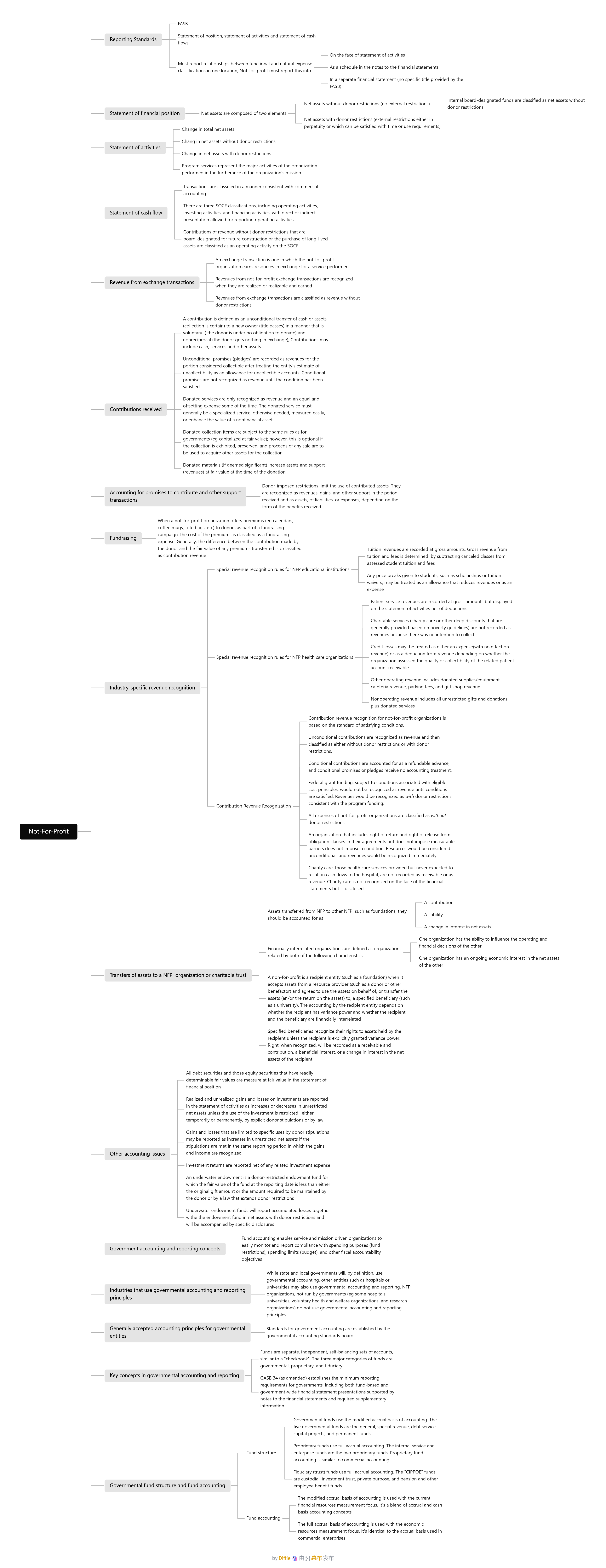
Here’s Difie’s mindmap:







Leave a Reply